A
[](https://fuchsia.dev/docs/glossary#realm)
is the term for any
[](https://fuchsia.dev/docs/glossary#component)
and its
[](https://fuchsia.dev/docs/glossary#child-component-instance)
. In other words, realm is another
word for any sub-tree of the
[](https://fuchsia.dev/docs/glossary#component-instance-tree)
.
Component instances may contain [children](https://fuchsia.dev/fuchsia-src/concepts/components/v2/realms#child-component-instances). Each
[](https://fuchsia.dev/docs/glossary#child-component-instance)
in turn
defines its own
[](https://fuchsia.dev/docs/glossary#sub-realm)
. The union of these
sub-realms, along with the
[](https://fuchsia.dev/docs/glossary#parent-component-instance)
, is
equivalent to a subtree. Therefore, it is common to conceive of a realm as a
component instance along with its set of children.
Realms play a special role in the component framework. A realm is an
*encapsulation boundary* for component instances. This means:
- Realms act as a [](https://fuchsia.dev/docs/glossary#capability) boundary. It's up to the realm to decide whether a capability originating in the realm can be [](https://fuchsia.dev/docs/glossary#capability-routing) to component instances outside of the realm. This is accomplished through an [`expose`](https://fuchsia.dev/reference/cml#expose) declaration in a [component manifest](https://fuchsia.dev/fuchsia-src/concepts/components/v2/component_manifests.md).
- The internal structure of a sub-realm is opaque to the parent component instance. For example, the sub-realm could be structured either as one or multiple component instances, and from the perspective of the parent component instance this looks the same as long as the sub-realm [exposes](https://fuchsia.dev/reference/cml#expose) the same set of capabilities.
A realm also acts as an *ownership boundary* , that is, a child component
instance is the root of a sub-realm that is owned by the parent, who controls
its existence. See [Child component instances](https://fuchsia.dev/fuchsia-src/concepts/components/v2/realms#child-component-instances) for
more information.
## Example
Here is an example of a realm with a capability routed through it:
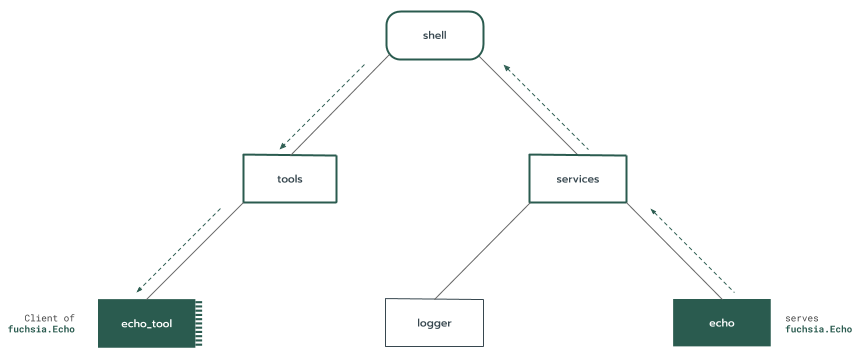
In this example, the `shell` component has two children: `tools` and `services`.
`services` has two children, `logger` and `echo`, while `tools` has one child
`echo_tool`. Components encapsulate their children, so while the `shell`
component sees its own children, it has no direct knowledge of its grandchildren
`echo_tool`, `logger`, or `echo`. Nevertheless, all of these component instances
are considered part of the `shell` realm.
The arrows illustrate the path of an `fuchsia.Echo` service capability that is
routed through the realm from `echo` to `echo_tool`. The upward arrows
correspond to [`expose`](https://fuchsia.dev/reference/cml#expose) declarations, while the downward arrows
represent [`offer`](https://fuchsia.dev/reference/cml#offer) declarations. The `expose` declarations cause
`fuchsia.Echo` to be exposed outside of the capability boundary of the
corresponding realms. For example, if `services` did not expose `fuchsia.Echo`,
`shell` would not be aware that `fuchsia.Echo` exists, and could not offer the
service to its children or access it at runtime.
For a more detailed walkthrough of capability routing with this example, see the
[component manifest capability routing example](https://fuchsia.dev/fuchsia-src/concepts/components/v2/component_manifests.md#examples).
## Child component instances
Component instances may contain children. Child component instances are
considered part of the parent instance's definition and are wholly owned by the
parent. This has the following implications:
- A component instance decides what children it contains, and when its children are created and destroyed.
- A component instance cannot exist without its parent.
- A component instance may not execute unless its parent is executing.
- A component instance determines the capabilities available to its children by making [`offer`](https://fuchsia.dev/reference/cml#offer) declarations to them.
- A component instance has some degree of control over the behavior of its children. For example, a component instance may bind to capabilities exposed from the child's realm through the [`Realm`](https://fuchsia.dev/fuchsia-src/concepts/components/v2/realms#realm-framework-protocol) framework service, or set hooks to intercept child lifecycle events. This control is not absolute, however. For example, a component instance cannot use a capability from a sub-realm that was not explicitly exposed to it.
There are two varieties of child component instances, [static](https://fuchsia.dev/fuchsia-src/concepts/components/v2/realms#static-children)
and [dynamic](https://fuchsia.dev/fuchsia-src/concepts/components/v2/realms#dynamic-children).
### Static children
A *static child* is a component instance that was statically declared in the
component's [manifest](https://fuchsia.dev/fuchsia-src/concepts/components/v2/component_manifests.md) by a [`children`](https://fuchsia.dev/reference/cml#children)
declaration. This declaration is necessary and sufficient to establish the child
component instance's existence.
Typically, a child should be statically declared unless it has a reason to be
dynamic (see [Dynamic children](https://fuchsia.dev/fuchsia-src/concepts/components/v2/realms#dynamic-children)). When a child is statically
declared, its definition and capabilities can be audited and capabilities can be
statically routed from it.
A static child is defined, foremost, by two pieces of information:
- The child instance's *name* . The name is local to the parent component instance, and is used to form [monikers](https://fuchsia.dev/fuchsia-src/concepts/components/v2/identifiers.md#monikers). It is valid to declare multiple children with the same URL and different names.
- The child instance's [component URL](https://fuchsia.dev/docs/concepts/components/v2/identifiers#component-urls).
For information on providing additional configuration information to child
declarations, see [children](https://fuchsia.dev/reference/cml#children).
### Dynamic children
A *dynamic child* is a component instance that was created at runtime in a
[component collection](https://fuchsia.dev/fuchsia-src/concepts/components/v2/realms#collections). A dynamic child is always scoped
to a particular collection. Dynamic children can be used to support use cases
where the existence or cardinality of component instances cannot be determined
in advance. For example, a testing realm might declare a collection in which
test component instances can be created.
Most of the metadata to create a dynamic child is identical to that used to
declare a static instance, except that it's provided at runtime. The name of a
dynamic child is implicitly scoped to its collection; thus it is possible to
have two dynamic children in two different collections with the same name.
Capabilities cannot be statically routed from dynamic instances. This is an
inherent restriction: there's no way to statically declare a route from a
capability exposed by a dynamic instance. However, certain capabilities can be
routed from the collection as a whole. TODO: service directories as an example
### Component collections
A *collection* is a container for [dynamic children](https://fuchsia.dev/fuchsia-src/concepts/components/v2/realms#dynamic-children) that
may be created and destroyed at runtime using the
[Realm](https://fuchsia.dev/fuchsia-src/concepts/components/v2/realms#realm-framework-protocol) framework service.
Collections support two modes of *durability*:
- *Transient* : The instances in a *transient* collection are automatically destroyed when the instance containing the collection is stopped.
- *Single Run* : The instances in a *single run* collection are started when they are created, and destroyed when they are stopped. This means that the instances in a single run collection can only be run once.
For more information about component execution and persistence, see
[lifecycle](https://fuchsia.dev/docs/concepts/components/v2/lifecycle).
Collections are declared in the [`collections`](https://fuchsia.dev/reference/cml#collections) section of a
component manifest. When an [`offer`](https://fuchsia.dev/reference/cml#offer) declaration targets a collection,
the offered capability is made available to every instance in the collection.
Some capabilities can be exposed or offered from the collection as a whole, as
an aggregation over the corresponding capabilities exposed by the instances in
the collection.
TODO: service directories as an example
#### Example
The following diagram illustrates a realm with a collection:
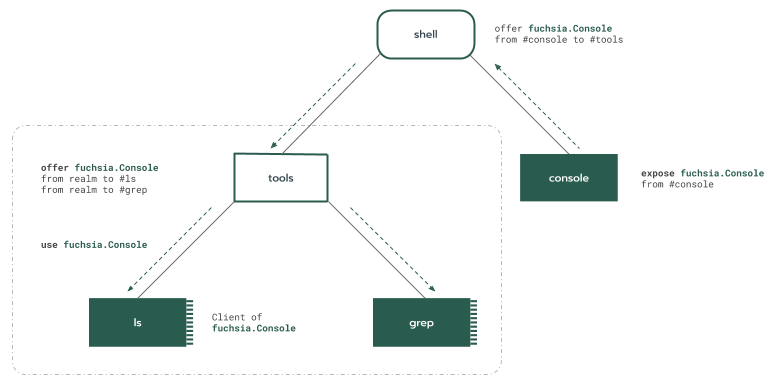
In this example, the `shell` component declares a static child `console` and a
collection `(tools)`, highlighted by the grey background (the `()` notation
denotes a collection). `(tools)` contains two dynamic instances, `ls` and
`grep`. These instances are dynamic children of `shell`, scoped to `(tools)`.
The use of a collection implies that the existence of `ls` and `grep` is not
known in advance. This is plausible if you imagine that `ls` and `grep` are
command-line tools that are instantiated on demand as the user requests them.
The example also illustrates a capability routing path with the arrows. First,
`console` [exposes](https://fuchsia.dev/reference/cml#expose) `fuchsia.Console` to its parent `shell`, which
[offers](https://fuchsia.dev/reference/cml#offer) it to `(tools)`. `fuchsia.Console` then becomes available for
any component instance in the collection to [use](https://fuchsia.dev/reference/cml#use) -- it does not need to be
routed to the dynamic instances independently.
## Environments
Every realm is assigned an [environment](https://fuchsia.dev/fuchsia-src/concepts/components/v2/environments.md), which configures certain
choices the framework makes for components in a realm. For example,
[runner capabilities](https://fuchsia.dev/fuchsia-src/concepts/components/v2/capabilities/runner.md) are registered to an environment, which makes
them available to any component instance in the realm. Read
[Environments](https://fuchsia.dev/fuchsia-src/concepts/components/v2/environments.md) for information on what properties are configurable
through the environment.
## The Realm framework protocol
There is a [framework protocol](https://fuchsia.dev/fuchsia-src/concepts/components/v2/capabilities/protocol.md#framework) available to every
component, [`fuchsia.component.Realm`](https://fuchsia.dev/reference/fidl/fuchsia.component#Realm). The `Realm` protocol provides
APIs for a component instance to manage the children in its realm, such as
binding to children and creating dynamic children. See the linked FIDL
definitions for full documentation.
[](https://issues.fuchsia.dev/issues/new?component=1439230&template=1881640&description=Issue+on:+https://fuchsia.dev/docs/concepts/components/v2/realms.md "Report a bug or suggest improvements on this page") [](https://cs.opensource.google/fuchsia/fuchsia/+/main:docs/concepts/components/v2/realms.md "View the source code of this page") [](https://ci.android.com/edit?repo=fuchsia/fuchsia/main&file=docs/concepts/components/v2/realms.md&cloneRepo=fuchsia/fuchsia:refs/heads/main&fullPath=fuchsia/docs/concepts/components/v2/realms.md "Edit the source code of this page")