Integration testing scenarios involve two or more components operating in the
same realm and exchanging capabilities. While the majority of tests are unit
tests that span only a single component, integration testing scenarios call for
defining realm topologies and capability routes.
## Test Runner Framework integration
The integration test component integrates with the [Test Runner Framework](https://fuchsia.dev/fuchsia-src/development/testing/components/test_runner_framework) by
including the test runner shard matching the supported language-specific testing framework.
### Rust
include: [
"//src/sys/test_runners/rust/default.shard.cml",
"syslog/client.shard.cml",
],
// Information about the program to run.
program: {
// The binary to run for this component.
binary: "bin/echo_integration_test_rust",
},
### C++
include: [
"//src/sys/test_runners/gtest/default.shard.cml",
"inspect/offer.shard.cml",
"syslog/client.shard.cml",
],
// Information about the program to run.
program: {
// The binary to run for this component.
binary: "bin/echo_integration_test_cpp",
},
This shard provides two key elements:
1. Expose the `fuchsia.test.Suite` protocol, required for the framework to discover and execute the test cases.
2. Set the program `runner` to the test runner provided for the given testing framework.
## Test realm topology
The integration test component declares the topology of the test realm with
itself as the parent. This allows the test controller to be responsible for
capability routing between components under test and their dependencies.
The following is an example topology for integration testing the `echo_server`
component:
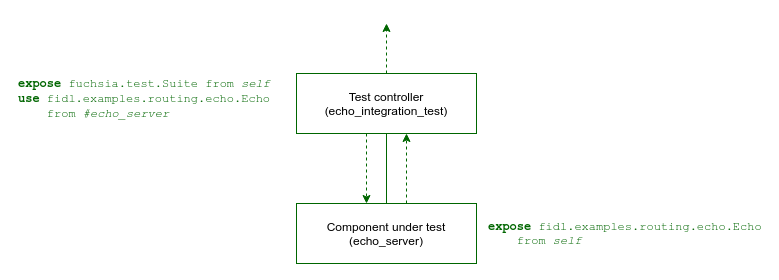
This is a simple test realm that binds to the `fidl.examples.routing.echo.Echo`
protocol exposed by the `echo_server` component.
The `echo_integration_test` package contains the following components:
- **echo_integration_test** - Test controller component
- **echo_server** - Component under test
You can define the test realm topology in the following ways:
- [Realm Builder](https://fuchsia.dev/fuchsia-src/development/testing/components/integration_testing#realm-builder): Dynamically in code using the Realm Builder library.
- [Component manifests](https://fuchsia.dev/fuchsia-src/development/testing/components/integration_testing#static-cml): Statically using component manifest language (CML).
Use the following table to help determine which approach is best for your integration tests:
| Integration test cases | Realm Builder | Static CML |
|---|---|---|
| Simple integration tests with static dependencies | Yes | Yes |
| Unique component instances for each test case | Yes | No |
| Lifecycle of components under test bound to each test case | Yes | No |
| Dynamic fake, mock, and stub instances for components under test | Yes | No |
| Dynamic routing and configuration between test cases | Yes | No |
### Realm Builder
> [!NOTE]
> **Note:** Consider using a [test realm factory](https://fuchsia.dev/docs/development/testing/components/test_realm_factory) component rather than using Realm Builder directly in a test suite.
In cases where realm topology needs to be defined at runtime, or components
need to be replaced with local mock implementations, you can use the Realm Builder
library to create the topology dynamically in your test code.
> [!NOTE]
> **Note:** You can find the example code referenced in this section under [`//examples/components/realm_builder`](https://cs.opensource.google/fuchsia/fuchsia/+/main:/examples/components/realm_builder/).
The test controller component's manifest includes the Realm Builder library using
its component manifest shard:
### Rust
include: [
"sys/component/realm_builder.shard.cml",
// ...
],
### C++
include: [
"sys/component/realm_builder.shard.cml",
// ...
],
The test controller code constructs the test realm topology, adding `echo_server` as a
child component and declaring the necessary capability routes back to the parent:
### Rust
use {
// ...
fuchsia_component_test::{
Capability, ChildOptions, LocalComponentHandles, RealmBuilder, Ref, Route,
},
futures::{StreamExt, TryStreamExt},
};
// ...
let builder = RealmBuilder::new().await?;
// Add component to the realm, which is fetched using a URL.
let echo_server = builder
.add_child(
"echo_server",
"fuchsia-pkg://fuchsia.com/realm-builder-examples#meta/echo_server.cm",
ChildOptions::new(),
)
.await?;
builder
.add_route(
Route::new()
.capability(Capability::protocol_by_name("fidl.examples.routing.echo.Echo"))
.from(&echo_server)
.to(Ref::parent()),
)
.await?;
### C++
#include
// ...
RealmBuilder builder = RealmBuilder::Create();
// Add component server to the realm, which is fetched using a URL.
builder.AddChild("echo_server",
"fuchsia-pkg://fuchsia.com/realm-builder-examples#meta/echo_server.cm");
builder.AddRoute(Route{.capabilities = {Protocol{.name = "fidl.examples.routing.echo.Echo"}},
.source = ChildRef{"echo_server"},
.targets = {ParentRef()}});
The test controller code interacts with the `echo_server` through the capabilities
exposed by the created realm:
### Rust
let realm = builder.build().await?;
let echo: fecho::EchoProxy = realm.root.connect_to_protocol_at_exposed_dir()?;
assert_eq!(echo.echo_string(Some("hello")).await?, Some("hello".to_owned()));
### C++
RealmRoot realm = builder.Build(dispatcher());
zx::result> client_end =
realm.component().Connect();
ASSERT_FALSE(client_end.is_error()) << client_end.status_string();
fidl::SyncClient echo_client(std::move(*client_end));
fidl::Result<::fidl_examples_routing_echo::Echo::EchoString> result =
echo_client->EchoString({"hello"});
ASSERT_EQ(result->response(), "hello");
For complete details on implementing tests using Realm Builder, see the
[Realm Builder](https://fuchsia.dev/docs/development/testing/components/realm_builder) developer guide.
### Component manifests
In cases where all components in the test are static, you can define the entire topology
for the test realm declaratively using CML in the component manifest for the test controller.
> [!NOTE]
> **Note:** You can find the example code referenced in this section under [`//examples/components/routing/integration_tests`](https://cs.opensource.google/fuchsia/fuchsia/+/main:/examples/components/routing/integration_tests/).
The test controller component's manifest statically declares the `echo_server`
component under test as a child, and routes the necessary capabilities back to
the parent:
### Rust
{
include: [
"//src/sys/test_runners/rust/default.shard.cml",
"syslog/client.shard.cml",
],
// Information about the program to run.
program: {
// The binary to run for this component.
binary: "bin/echo_integration_test_rust",
},
// Child components orchestrated by the integration test.
children: [
{
name: "echo_server",
url: "#meta/echo_server.cm",
},
],
// Capabilities used by this component.
use: [
{
protocol: [ "fidl.examples.routing.echo.Echo" ],
from: "#echo_server",
},
],
// Capabilities required by components under test.
offer: [
{
dictionary: "diagnostics",
from: "parent",
to: "#echo_server",
},
],
}
### C++
{
include: [
"//src/sys/test_runners/gtest/default.shard.cml",
"inspect/offer.shard.cml",
"syslog/client.shard.cml",
],
// Information about the program to run.
program: {
// The binary to run for this component.
binary: "bin/echo_integration_test_cpp",
},
// Child components orchestrated by the integration test.
children: [
{
name: "echo_server",
url: "#meta/echo_server.cm",
},
],
// Capabilities used by this component.
use: [
{
protocol: [ "fidl.examples.routing.echo.Echo" ],
from: "#echo_server",
},
],
}
The test controller code interacts with the `echo_server` through its exposed
capabilities:
### Rust
use anyhow::Error;
use fidl_fidl_examples_routing_echo as fecho;
use fuchsia_component::client;
#[fuchsia::test]
async fn echo_integration_test() -> Result<(), Error> {
const ECHO_STRING: &str = "Hello, world!";
let echo = client::connect_to_protocol::()
.expect("error connecting to echo server");
let out = echo.echo_string(Some(ECHO_STRING)).await.expect("echo_string failed");
assert_eq!(ECHO_STRING, out.unwrap());
Ok(())
}
### C++
#include
#include
#include
#include
#include
TEST(EchoIntegrationTest, TestEcho) {
::fidl::examples::routing::echo::EchoSyncPtr echo_proxy;
auto context = sys::ComponentContext::Create();
context->svc()->Connect(echo_proxy.NewRequest());
::fidl::StringPtr request("Hello, world!");
::fidl::StringPtr response = nullptr;
ASSERT_TRUE(echo_proxy->EchoString(request, &response) == ZX_OK);
ASSERT_TRUE(request == response);
}
## Test package
All components under test are included in the same **hermetic test package**.
This promotes the ability to run and update tests in different environments
without concern for dependencies falling out of sync.
See the following `BUILD.gn` file that defines a `fuchsia_test_package()` target for this example:
### Rust
rustc_test("bin") {
name = "echo_integration_test_rust"
edition = "2024"
deps = [
"//examples/components/routing/fidl:echo_rust",
"//src/lib/fuchsia",
"//src/lib/fuchsia-component",
"//third_party/rust_crates:anyhow",
]
sources = [ "src/lib.rs" ]
}
fuchsia_component("echo_integration_test_component") {
testonly = true
component_name = "echo_integration_test"
manifest = "meta/echo_integration_test.cml"
deps = [ ":bin" ]
}
fuchsia_test_package("echo_integration_test_rust") {
test_components = \[ ":echo_integration_test_component" \]
deps = \[ "//examples/components/routing/rust/echo_server:echo_server_cmp" \]
}
### C++
executable("bin") {
output_name = "echo_integration_test_cpp"
sources = [ "echo_integration_test.cc" ]
deps = [
"//examples/components/routing/fidl:echo_hlcpp",
"//sdk/lib/async-loop:async-loop-cpp",
"//sdk/lib/async-loop:async-loop-default",
"//sdk/lib/sys/cpp",
"//sdk/lib/sys/cpp/testing:unit",
"//src/lib/fxl/test:gtest_main",
"//third_party/googletest:gtest",
]
testonly = true
}
fuchsia_component("echo_integration_test_component") {
testonly = true
component_name = "echo_integration_test"
manifest = "meta/echo_integration_test.cml"
deps = [ ":bin" ]
}
fuchsia_test_package("echo_integration_test_cpp") {
test_components = \[ ":echo_integration_test_component" \]
deps = \[ "//examples/components/routing/cpp/echo_server:echo_server_cmp" \]
}
Components are built into the `fuchsia_test_package()` using the following variables:
- `test_components`: Components containing tests that expose the `fuchsia.test.Suite` protocol.
- `deps`: Additional component dependencies required by the integration test.
For more details, see [Test package GN templates](https://fuchsia.dev/docs/development/components/build#test-packages).
## Test component monikers
A component's moniker identifies the unique instance in the component topology.
For components running inside of a test topology, the moniker path is relative to
the root component in the test realm. In the above example, the root component is
the test controller component that exposes the `fuchsia.test.Suite` protocol.
The child moniker format depends on your [test realm topology](https://fuchsia.dev/fuchsia-src/development/testing/components/integration_testing#test-topology):
- **Static CML** : Components declared statically as children of the root test controller are simply identified by their component `name`.
- **Realm Builder** : Realm Builder introduces an intermediate collection between the test controller and child components. For more details on test component monikers with Realm Builder, see the [Realm Builder](https://fuchsia.dev/docs/development/testing/components/realm_builder#test-component-moniker) developer guide.
[](https://issues.fuchsia.dev/issues/new?component=1439230&template=1881640&description=Issue+on:+https://fuchsia.dev/docs/development/testing/components/integration_testing.md "Report a bug or suggest improvements on this page") [](https://cs.opensource.google/fuchsia/fuchsia/+/main:docs/development/testing/components/integration_testing.md "View the source code of this page") [](https://ci.android.com/edit?repo=fuchsia/fuchsia/main&file=docs/development/testing/components/integration_testing.md&cloneRepo=fuchsia/fuchsia:refs/heads/main&fullPath=fuchsia/docs/development/testing/components/integration_testing.md "Edit the source code of this page")